

Казахтелеком

73%

4.1. Sustainable development management

4.1.6. Interaction with stakeholders

GRI 2-26, 2-29

4.1.6.1. Approach to the management of interaction with stakeholders

Kazakhtelecom JSC develops interaction with stakeholders as an element of sustainable development and corporate governance. The Company builds a systemic and transparent dialogue aimed at the timely identification of expectations, the enhancement of the level of trust and the strengthening of long-term partnership relations. Such an approach contributes to the making of well-grounded management decisions and enhances the resilience of the business in a rapidly changing external context.

Principles of the Company’s interaction with stakeholders:

Materiality

the Company determines the key groups of stakeholders and the issues material to them.

1

Completeness

the Company takes into account the views, needs and expected results of interaction with stakeholders.

2

Responsiveness

the Company consistently responds to material issues facing stakeholders and the organization itself.

3

4.1.6.2. Map of stakeholders

А At the Company, the main groups of stakeholders have been identified and a map of stakeholders has been developed, which is updated with account for international standards and best practices.

Kazakhtelecom JSC singles out two groups of stakeholders and reflects the contribution of each group in the Map of interaction with stakeholders:
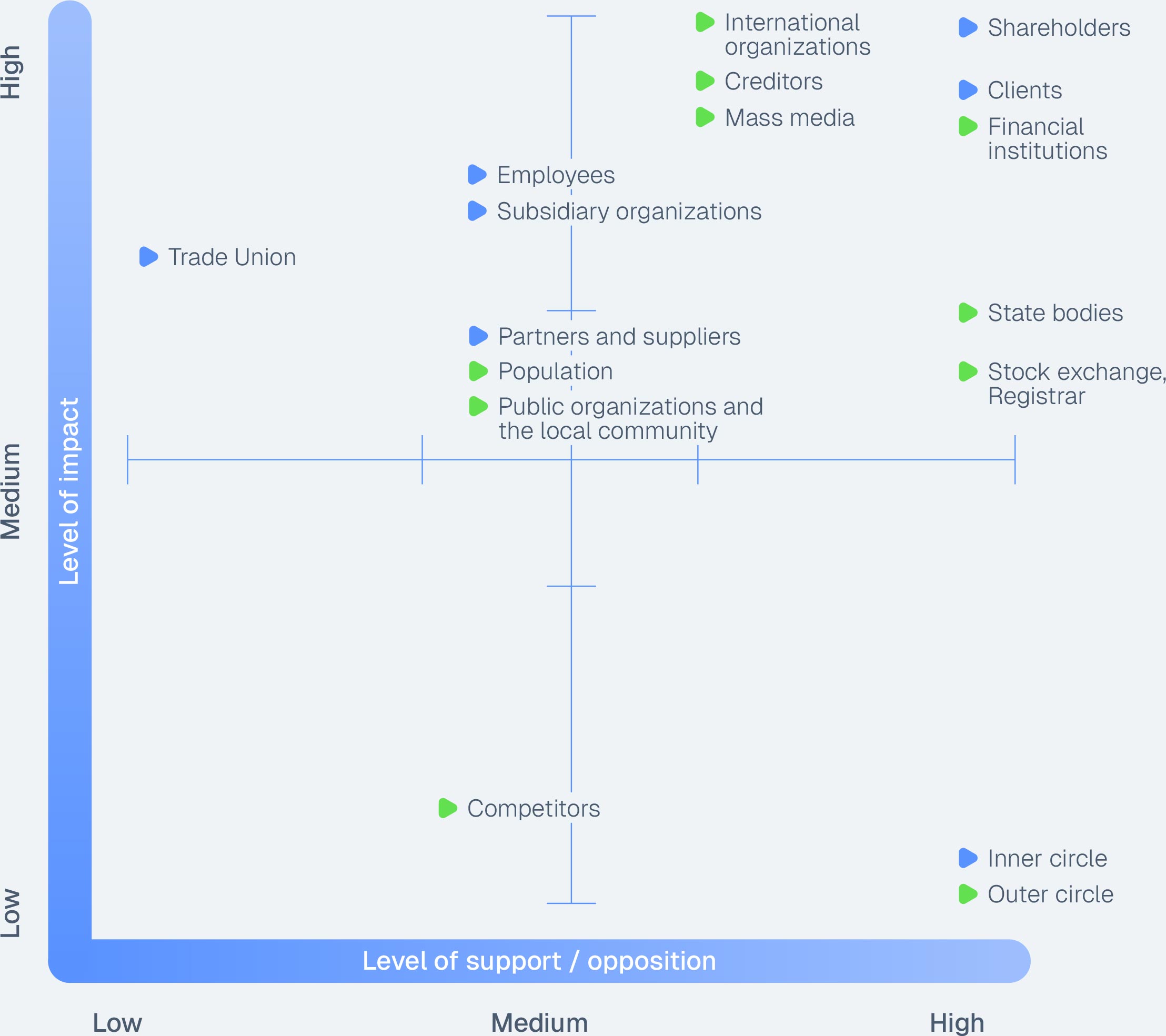
  • The inner circle (the area of inner influence) includes stakeholders that have direct and material impact on the decisions made by the Company or are subject to the impact of these decisions. The inner circle of stakeholders includes:
  • Shareholders.
  • Employees.
  • Subsidiary organizations.
  • Trade union.
  • Partners (including international) and suppliers of works and services.
  • Clients.
  • The outer circle (the area of indirect influence) includes stakeholders that have indirect impact on the decisions made by the Company. The outer circle of stakeholders includes:
  • State bodies.
  • Competitors.
  • International organizations.
  • Financial institutions.
  • Creditors.
  • Stock exchange, Registrar.
  • Population.
  • Public organizations and the local community. А
  • Mass media.
Map of stakeholders of Kazakhtelecom JSC

The map of stakeholders of the Company was updated in 2023. The updated Map of stakeholders of the Company can be reviewed on the Company’s website telecom.kz.

Table 16. Map of interaction with stakeholders А

Inner circle of stakeholders

Shareholders

Interests
  • enhancement of the Company’s value;
  • receipt of dividends;
  • stability and expansion of the scale of the Company’s activities;
  • transparency;
  • effective risk management;
  • maximisation of the Company’s value and the dividend amount.
Contribution
  • allocation of financial resources;
  • replenishment of the authorised capital.
Engagement mechanisms
  • payment of dividends;
  • approval of annual financial and non-financial reporting;
  • implementation of the JRun transformation programme;
  • holding of meetings, negotiations and gatherings;
  • discussion and adoption of key, strategic and investment decisions;
  • conducting surveys, questionnaires and testing.

Employees

Interests
  • the Company’s results and achievements;
  • prospects for the Company’s development;
  • HR and social policy;
  • safe and comfortable working conditions;
  • observance of human rights;
  • engagement and development prospects of personnel;
  • measures of material and non-material motivation, youth policy;
  • Collective Agreement.
Contribution
  • human resources;
  • loyalty.
Engagement mechanisms
  • implementation of measures for the creation of safe and decent working conditions;
  • engagement of employees in the process of managing the Company;
  • social benefits;
  • corporate training and development programmes;
  • regular meetings with management;
  • operation of intra-corporate communication channels, hotline;
  • online feedback mechanisms (surveys/questionnaires).

Subsidiary organizations

Interests
  • observance of the interests of shareholders/participants.
Contribution
  • observance of the interests of shareholders.
Engagement mechanisms
  • conduct of regular monitoring of the results of the activities of Subsidiaries;
  • continuation of work on the development of the mobile business jointly with Subsidiaries;
  • participation of Subsidiaries in the adoption of the Company’s strategic decisions as a shareholder.

Trade Union

Interests
  • social responsibility and protection of employees;
  • fulfilment of the terms of the Collective Agreement;
  • compliance with legislative norms.
Contribution
  • promotion of social stability;
  • regulation of labour relations and resolution of conflicts.
Engagement mechanisms
  • fulfilment of all clauses of the Collective Agreement;
  • provision of material assistance to the Company’s employees in the form of interest-free loans;
  • holding of public hearings;
  • operation of intra-corporate communication channels, hotline.

Partners and suppliers

Interests
  • commercial interests.
Contribution
  • joint project implementation;
  • transfer of technologies, competencies and innovations.
Engagement mechanisms
  • mutually beneficial cooperation;
  • participation of partners in the adoption of the Company’s strategic decisions as a shareholder;
  • meetings, negotiations, business correspondence;
  • reports on current activities.

Clients

Interests
  • commercial interests;
  • quality characteristics of services;
  • continuity of service provision;
  • qualified service support.
Contribution
  • loyalty to the Company;
  • financial resources through the acquisition of goods and services.
Engagement mechanisms
  • engagement within the framework of contracts;
  • enhancement of service quality;
  • online service;
  • expansion and improvement of support service channels;
  • consumer feedback system;
  • analysis of consumer satisfaction.

Outer circle of stakeholders

Government bodies

Interests
  • exercise of legislative and executive functions;
  • implementation of state policy in the area of telecommunications, creation of jobs.
Contribution
  • state regulation.
Engagement mechanisms
  • working groups, forums, conferences;
  • meetings, negotiations, business correspondence;
  • timely submission of reports on current activities;
  • provision of feedback;
  • verification of compliance with the legislation of the RK.

Competitors

Interests
  • increase in market share.
Contribution
  • market development.
Engagement mechanisms
  • adherence to the principle of fair competition.

International organizations

Interests
  • development of international cooperation between ITU and RCC member countries, exchange of experience, adoption of common standards in the use of technologies;
  • ensuring the requirements of international standards and agreements in the area of sustainable development, fair and balanced growth in compliance with environmental norms and in the development of infocommunication services.
Contribution
  • international grants;
  • opportunities for future development.
Engagement mechanisms
  • conferences, sessions, meetings, forums;
  • signing of agreements, contracts and memoranda, cooperation agreements.

Financial institutions

Interests
  • placement of free funds on deposits, servicing of special accounts.
Contribution
  • Provision of favourable conditions for the placement of funds.
Engagement mechanisms
  • engagement within the framework of contracts.

Creditors

Interests
  • targeted use of funds;
  • compliance with the terms of credit agreements;
  • timely repayment of the principal and interest;
  • stability and transparency of the Company’s activities.
Contribution
  • provision of funds.
Engagement mechanisms
  • engagement within the framework of contracts;
  • general meeting of bondholders;
  • disclosure of information through the media and the Company’s website.
  • submission of reports in accordance with the requirements of credit agreements.

Exchange, Registrar

Interests
  • development of the securities market (listing rules, registrar rulebook)
Contribution
  • opportunity to participate in the development of the securities market.
Engagement mechanisms
  • negotiations, meetings with stakeholders;
  • provision of feedback through the media.

Population

Interests
  • creation of jobs;
  • transparent information about the Company’s development prospects;
  • quality of services;
  • attractiveness of service tariffs;
  • social and charitable programmes;
  • health safety.
Contribution
  • support in the regions of the Company’s presence.
Engagement mechanisms
  • development of the regions of presence;
  • engagement through social networks, hotline;
  • reputational audit;
  • charitable activities;
  • public reporting.

Public organizations

Interests
  • various issues, within the framework of the activities of public, non-governmental organizations.
Contribution
  • cooperation on mutually beneficial terms.
Engagement mechanisms
  • engagement within the framework of agreements;
  • public reporting.

Mass media

Interests
  • informing the public about the Company’s activities.
Contribution
  • constructive cooperation;
  • favourable public opinion.
Engagement mechanisms
  • publication of information about the Company in the media;
  • social networks, hotline;
  • provision of responses to media inquiries;
  • public reporting.

4.1.6.3. Plan on interaction with stakeholders

On the basis of the map, the Company annually approves the Plan on interaction of Kazakhtelecom JSC with stakeholders, which determines the key groups of stakeholders, the interests of stakeholders, the goals of interaction and informing, communication channels, frequency, responsible subdivisions and the format of accounting for the feedback received. In 2025, the updated Plan on interaction for 2026 was developed and approved. The updated version of the Plan can be reviewed on the Company’s website telecom.kz.

4.1.6.4. Channels of interaction with stakeholders

The Company adheres to the principles of information openness and transparency and provides stakeholders with information about its activities.

Kazakhtelecom JSC interacts with stakeholders using various communication channels:
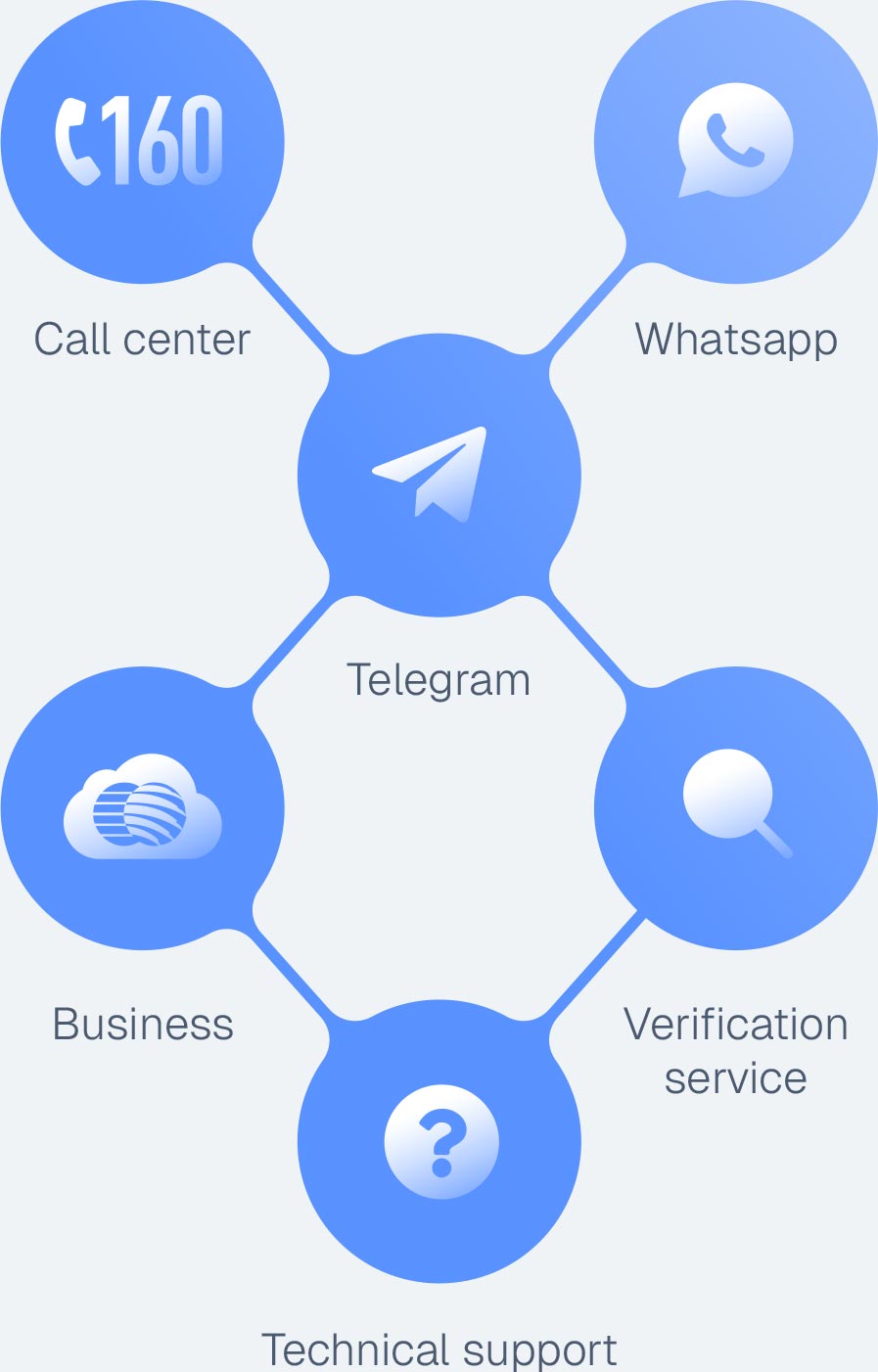
  • Information about the Company’s activities is placed on the website telecom.kz;
  • Information about the Company’s activities material for shareholders is published in the Company’s annual reports;
  • Online communication channels;
  • News about corporate projects, training and development programmes, and also motivation and social benefits for employees the Company publishes on the internal corporate portal;
  • A Hotline is operating for requests related to violations of legislation (fraud, corruption, discrimination, unethical behaviour, etc.);
  • A special platform with information for B2B clients ismet.kz is operating;
  • News of the Company is published in the mass media.

4.1.6.5. Feedback tracking and tools

The Company takes into account feedback through the following channels and tools. The feedback received based on the results of interaction is analysed by the relevant subdivisions, and the results are integrated into strategic planning and are taken into account in the process of identification of risks. Stakeholder requests are submitted to the Audit and Sustainability Committee for review. Further, the Company develops corresponding plans of corrective measures and roadmaps on the improvement of ESG practices, which include measures on the correction of internal procedures, the development of client services, the improvement of working conditions, the improvement of procurement processes, etc.

On a regular basis, the accounting of feedback is carried out by means of the following channels:

  • Hotline for requests related to violations of legislation (fraud, corruption, discrimination, unethical behaviour, etc.);
  • Corporate website, mobile application and contact centre;
  • Measurement of the client loyalty index NPS / tNPS / eNPS and analysis of its changes with the development of a plan of corrective measures;
  • Annual sociological research Samruk Research Services / social survey and the development of a Plan of measures on work over the alarming zones;
  • Procurement portal and direct line for suppliers;
  • Internal corporate portal;
  • Requests through state bodies and external channels;
  • Assessments of impact on local communities upon the development of new projects and the holding of public hearings to take into account the opinions and wishes of stakeholders.

4.1.6.6. Assessment of the effectiveness of interaction in 2025

Within the framework of the accounting of feedback, an assessment of the effectiveness of interaction with stakeholders is conducted. For this, at the strategic and operational levels of the Company, target effectiveness indicators are determined, which cover:

  • target levels of consumer loyalty indices NPS and eNPS, established as KPIs for top-level managers;
  • The SRS study included 2,544 persons;
  • The Well-being survey was undertaken by 1,203 employees;
  • number of client requests;
  • social stability / engagement index;
  • number of requests to the hotline;
  • number of events with suppliers;
  • share of digital requests;
  • share of requests resolved at first contact;
  • number of measures implemented based on the results of feedback.

1,203

employees

completed the Well-being survey

2,544

persons

included the SRS study